Three AI Futures
There's lots of conversation about the ultimate impact that AI technologies will have. There's far less about what comes between now and then. What an economy and society interwoven with AI Agents looks like. And the decisions that leaders will need to make in that world. This blog starts to explore that space.

Will AI technologies result in utopia, or existential crisis? Will all meaningful work disappear in a few years?
There's lots of conversation about the ultimate impact that AI technologies will have. There's far less about what comes between now and then: what it looks like when the economy and society are increasingly interwoven with AI agents, and what decisions leaders will need to make as we get there.
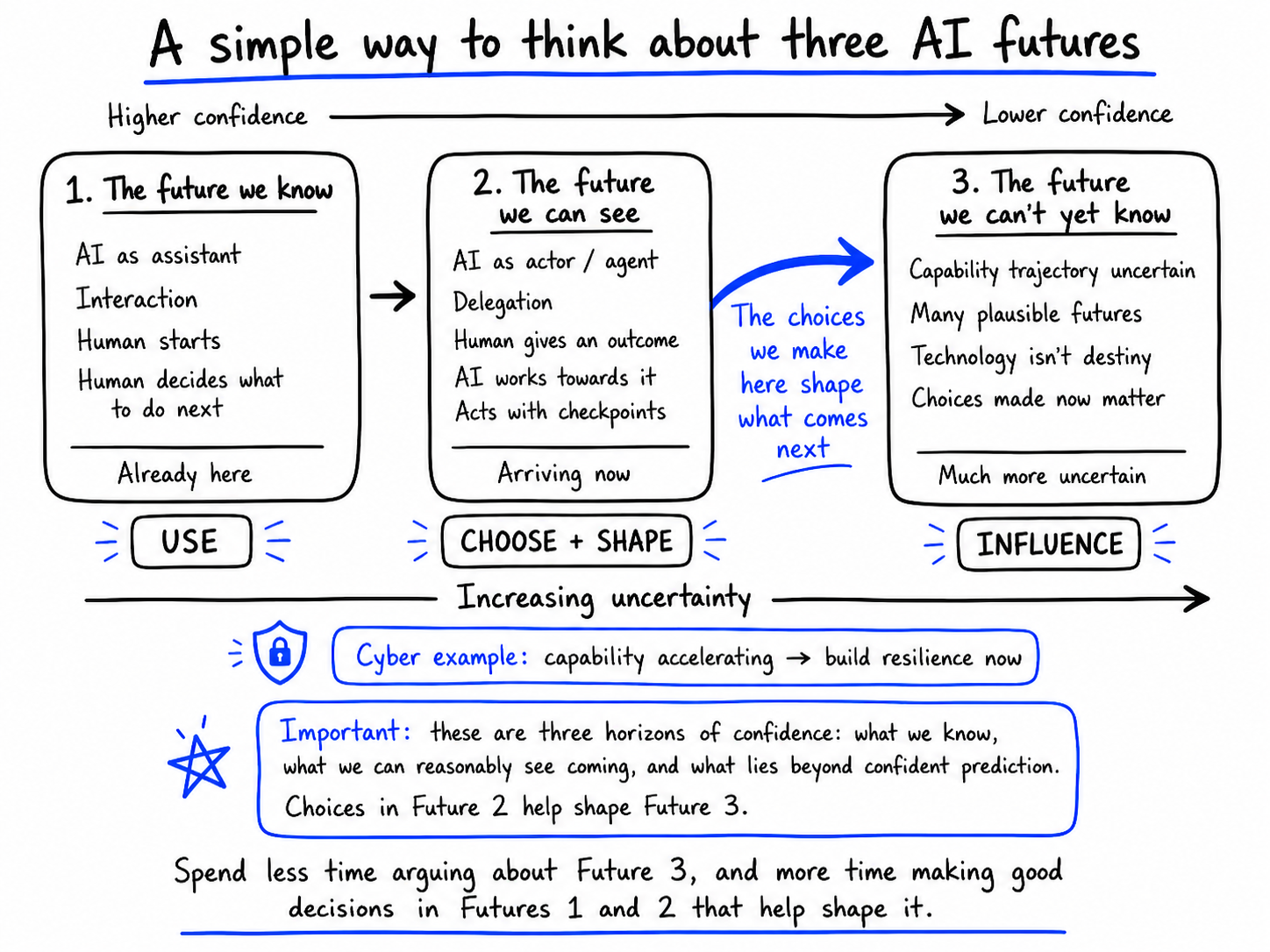
At AIConfident, one of the ways we try to cut through this uncertainty is through what we call three AI futures.
Not competing scenarios or predictions, but three horizons of confidence: the future we know because we are living it right now; the future we can see because the capabilities exist; and the future we don't yet know, where the range of plausible outcomes becomes much wider.
The choices organisations, leaders and individuals make in the first two of these, will shape which version of the less certain future eventually emerges.
A future we know
This is the future that we are in now.
Most people have access to general purpose generative AI technologies. Many are using them in a 'chat' function to save time and boost personal productivity, although organisations still struggle to translate that saved time into measurable organisational value.
Largely, though, people are under-utilising the capabilities available.
At the more advanced end, people are using AI to code, create applications, generate training videos and other content and redesign workflows. One IT Director at a client of ours, faced with a £100k quote for a piece of SaaS software, sat down with Claude Code and built the bespoke tool they needed in a weekend.
Some, but very few, teams are exploring how these tools change the way that they work, building 'Custom AI models' (eg basic Copilot Agents, GPTs, Gems or Skills) that change up their workflows.
Survey after survey tells us many people haven't had training or governance for the tools they've been given.
And in every organisation you will find people sceptical of AI technologies, with often very valid environmental or ethical concerns.
Search is changing. Many search engines return outputs generated by language models, changing up how we find and share information with one another, in some cases dramatically reducing website traffic.
Outside of the work environment, large numbers of people are using generative AI tools for things we'd often go to humans for - companionship, coaching, life planning - bringing with it under-explored risks around mental health, or what this means for learning, particularly for young people and new entrants to the workforce.
Open-source and open-weight AI models are also making increasingly powerful capabilities available for organisations that want greater control over where and how AI is deployed, removing dependance on the major consumer AI platforms.
Even if AI development stopped right now, the potential to redesign work and create value from the capabilities we already have would be huge.
And yet, most current use still has one important characteristic: a human remains at either end of the interaction.
A person asks the AI to do something. The AI produces an answer, analysis, image, piece of code or other output. And a person then decides what happens next. AI technologies help humans to do work.
All of this has happened in under 4 years.
--
A future we can see: Towards greater delegation
Imagine just asking for a train ticket to be booked and having the ticket arrive in your inbox without you having to do anything. Or asking an AI agent to identify suitable sales prospects, research them, draft personalised outreach and update your CRM. Or having agents handle large parts of a customer-service process, resolving straightforward cases and escalating only when human judgement is needed. Task after task gets done while you sleep, by a team of AI Agents working on your behalf.
You don’t need to imagine. The tools and capabilities to make this future real already exist, and are accessible to anyone.
AI Agents that can take actions on behalf of users, and achieve end-to-end goals now exist. Organisations are deploying them into areas such as customer service, IT support and software development. Individuals can also access increasingly general-purpose agentic capabilities through tools such as 'Cowork'.
Just this week, I gave Cowork the task of setting upour company on an EV salary-sacrifice scheme. It worked through multiple steps, completed forms and contacted our accountants, only coming back to me for approval where needed.
While 'Cowork' tools are reasonably well guardrailed, locally-hosted agents like OpenClaw, which have fewer guardrails, are accessible with a little determination. Within a week of launch, Moltbook, a social network built exclusively for AI agents had over 37,000 agents posting on it. Weeks later, security researchers found a leak of 1.5 million API keys and 35,000 users' private emails.
And Cyber is one area where this becomes important. AI systems are rapidly improving at finding vulnerabilities and carrying out multi-step attacks. Recent evaluations have seen models reach beyond enclosed testing environments. Sophisticated cyber capabilities are becoming cheaper, faster and more widely available.
The AI technologies have become more capable, but the human relationship with them is changing too.
Instead of asking AI to help us do the work, we are beginning to delegate large chunks of work to AI.
That raises a very different set of questions for leaders.
How does this change how work gets done? What work are we willing to delegate to AI? Where does human judgement still matter? What should agents be allowed to access and act on, and where should they have to check back with us?
And then more broadly: What happens when agents interact with one another? How do you know that your Agent is acting in your best interest, and not the interests of the provider, or a 3rd party?
And the same capabilities are available to others — including those who might use them to deceive people, attack systems or overwhelm services.
The impact is moving beyond software: China's recent robotics olympics showed just how fast generative AI is being connected to physical robots, taking action in the real world and not just in software.
None of this is fantasy. Everything I've described here exists already.
The uncertainty is how quickly technologies will improve, how widely they will be adopted, how teams will need to reshape, where organisations decide to deploy them, and what controls we put around them.
That makes this a particularly important period for leadership.
The norms, guardrails and patterns of use that organisations establish while these technologies are still developing will influence what becomes normal later.
Decisions about where we delegate to AI, where humans remain involved, what systems these agents can access and whose interests they should serve are all part of shaping the AI-enabled economy and society that comes next.
--
A future we don't yet know
And then there is the third future.
We don't currently know how far or how fast AI capabilities will progress. It may continue at something like its current pace. It could be accelerated substantially by breakthroughs, or intersections with technologies like quantum. Or any number of technical, economic, legal, physical or societal barriers could slow progress .
Some people expect AI systems eventually to match or exceed human capability across a very wide range of cognitive tasks, often described as Artificial General Intelligence, and potentially beyond that, Artificial Super Intelligence. Others expect the path to be slower, more uneven or more constrained.
But capability is only part of the story.
Even if extraordinarily capable AI becomes possible, the future we experience will also depend on where we choose to deploy it, what we allow it to do, who controls it, whose interests it serves, how its benefits are distributed, and where we decide that human involvement still matters.
That means Future 3 isn't simply something that happens to us.
The choices made during Future 2, by governments, technology companies, organisations, communities and individuals, will help determine which version of Future 3 emerges.
There are many possible outcomes between technological utopia and catastrophic doom. We shouldn't pretend we can confidently predict which one we'll get.
But uncertainty doesn't mean powerlessness. Even if we can't yet predict the third future, we can help shape it.
—
For leaders, the task ahead is clear.
In the future we know, it is to make much better use of capabilities that already exist: developing skills, creating cultures that steer teams through the redesign of work, building proportionate governance and engaging properly with the concerns people have about AI.
In the future we can see, the task is to decide what we are prepared to delegate: where AI agents should act, where humans should remain involved, what access they should have and how accountability should work.
For the future we don't yet know, our job isn't simply to wait and see.
The decisions we make in the first two futures help shape the third.
If we want an AI-enabled future in which these technologies create more good than harm, the choices that shape it are being made today by every leader across the economy and society
–--
Some interesting deeper reading
Our blog setting out different types of Agent
The Dilemmas of Delegation - Ada Lovelace Institute
ICO tech futures paper on Agents
--
How I used AI in writing this blog:
The initial writing was all my own. I have been talking about these three futures in our workshops with leaders for some time, so wrote down the kind of topics that I cover.
I invited Claude to challenge me on the purpose of the article, helping me to refine the subjects that I did/didn't include. I also asked Claude to find the specific research that I knew existed to back up some of the arguments, and to weave in specific text from articles that I wanted to include.
--
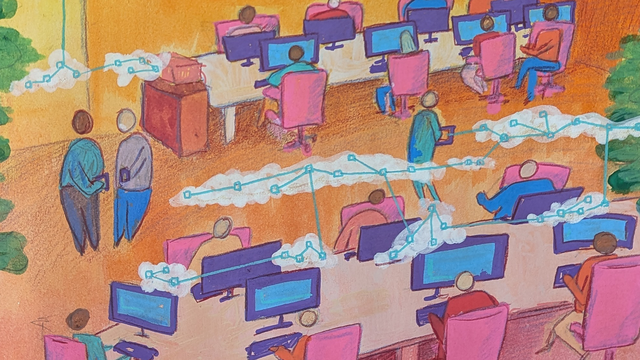
Image: Catherine Breslin & Rens Dimmendaal / https://betterimagesofai.org / https://creativecommons.org/licenses/by/4.0/
Read next

.png)

We give purpose-driven organisations the confidence to thrive in an AI-enabled world.
A bit about the images on our website: throughout our website we have used images from the wonderful Better Images of AI. They’re a great source of AI-related images, freely available under a Creative Commons license, that specifically avoid Humanoid robots, glowing brains, outstretched robot hands, blue backgrounds, and the Terminator!