Not all Agents are equal: Part 1
Demystifying AI Agents for non-technical leaders in 3 parts
Not all Agents are equal
(Updated 29 Aug '26 to reflect latest developments)
Demystifying AI Agents for non-technical leaders, helping you to put in place proportionate governance.
"AI Agents": One of the most used terms in AI in 2026. Every platform, every vendor update seems to feature new agent capabilities. They're getting easier to build, easier to deploy, and easier for anyone in your organisation to start using, with or without your knowledge. And some are incredibly capable. But they bring with them some risks that are materially different from those we see with existing chatbot platform. These need leadership focus now.
The ease of deploying a personal AI Agent
Recently, I downloaded Claude Cowork. It required no technical skill (and Claude talked me through every step). It is exceptional in its capability, able to use a multitude of tools to actually accomplish tasks in ways that previous Language Models have fallen short:
- "Look in this file, find every instance of a logo and collate them in another file". Done.
- "Find every instance I've written a bio, collate them in a document, then use them to write different versions of my bio for audiences x, y and z". Done
- "Take this description of one of our products, turn it into a diagram, using Canva, with our branding". Done
Clients are already asking us to help their teams integrate it into their AI capabilities.
But I could've plugged Cowork into my Inbox, Chrome, Drive, file structure and many other 'Connectors' that can be switched on with one click. Anthropic is clear, though, about the limitations and considerations when working with Cowork: "the risk of prompt injection attacks is non-zero. Users should avoid granting access to files with sensitive information"
This is just one window into the increasingly accessible and potentially wild-west world of AI Agents. AI agents can be incredibly powerful. How we manage their safe integration will be the biggest AI-related test for leaders yet.
- Too much governance and you miss out on potentially game-changing innovation.
- Too little governance, and you introduce potentially significant risks to your organisation.
This first post aims to establish enough shared, practical language to enable leaders across sectors to identify and categorise AI agents that they come across, in order to have a useful conversation about what needs governing, and how.
What makes something an AI agent?
"an automated entity that perceives its environment and takes actions to achieve its goals" is how ISO/IEC 22989 describes an AI agent. It's a useful starting point, but quite broad — which is why a set of practical characteristics helps us understand the range of different agents out there.
AI that makes choices about how to approach a task
Some agents go beyond following a set sequence of steps. They assess a situation and decide how to respond — which tool to use, what order to do things in, how to handle something unexpected. Often with little or no human oversight. Some can also retain information (memory) from previous interactions, building up context over time that shapes how they approach future tasks.
The level of human oversight we have over the decisions that an Agent makes, is a factor in determining risk.
AI tools that act autonomously
Another important characteristic is the degree of autonomy an agent has. It might:
- Start a task on its own (e.g. our 'AI tenders researcher' that starts every Monday morning and researches for potential tenders against a set of criteria)
- Complete a task on its own (e.g. an agent that, on instruction from a human, takes client details and updates a CRM)
- Both start and completes a task on its own (e.g. an agent that spots an email to a helpdesk, and sends a Teams message to available members of the team).
Starting a task on its own doesn't necessarily make something an Agent, but its level of autonomy is another factor in assessing the level of risk an AI Agent brings.
AI that uses tools and systems
In most cases, an agent uses (and is therefore connected to) tools and systems. Put simply, 'tools' can be things like: your email; a database; a CRM; the web; a codebase. These connections to 'tools' are what give an agent its capabilities.
The choices people make about which systems to connect, and what level of access to grant, is another factor that has direct bearing on the level of risk an agent carries.
Where might you encounter AI agents?
The characteristics above describe what agents can do. In practice, leaders are more likely to encounter them in four forms, which carry very different governance implications.
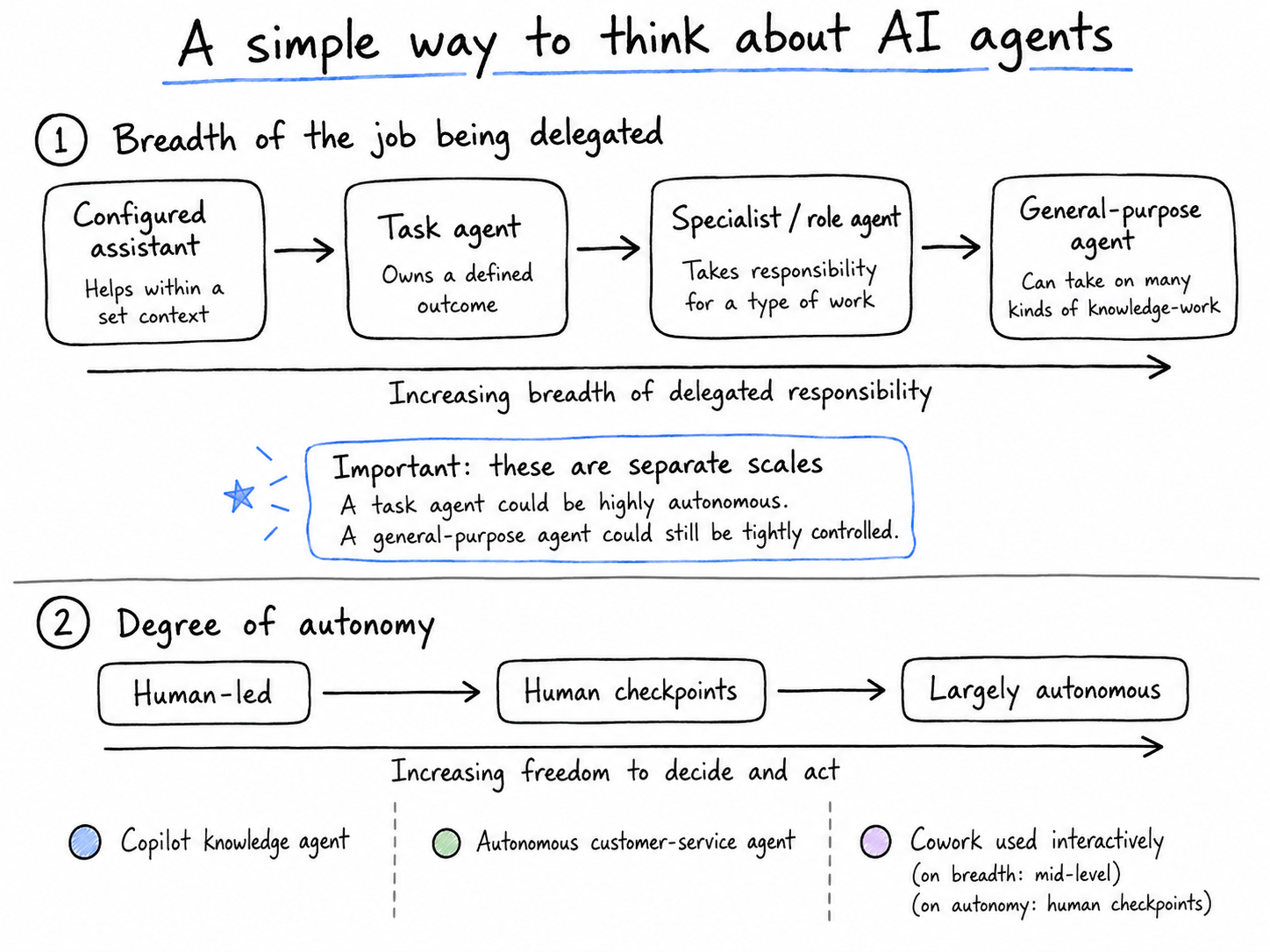
Customised AI models/Configured Assistant (sometimes called "agents", not always necessarily "agents")
Shows up as: Something built by one of your staff in Copilot, that is called an 'Agent'
Many of the things currently being labelled as "agents" are not necessarily 'agentic'. A Copilot Agent, in its simplest form, is a chatbot with custom instructions and access to a set of documents. Someone has configured it to respond in a particular way, perhaps for a specific audience or topic. Potentially very useful, but not really an 'Agent', and as a result, significantly lower risk.
Copilot Studio can be used to build tools with genuine agentic capability. The difficulty is that "agent" is being used to describe both a chatbot pointed at some documents, as well as a tool that autonomously acts on live systems. In reality, one needs to be governed quite differently to the other.
Task Agents
Shows up as: An agent built or procured to achieve a particular, defined outcome.
These agents have a relatively narrow mandate. They act, use tools and make decisions, but within defined boundaries.
You might have an agent that researches potential tenders against a set of criteria, processes an invoice, investigates an IT support ticket or triages an incoming request.
“Task” doesn't necessarily mean one action. Completing the task may involve multiple steps, several systems and decisions along the way. The important distinction is that the outcome it is responsible for is relatively tightly defined.
These agents may be bought as products, built centrally or increasingly created using low-code agent-building tools.
Specialist / Role Agents
Shows up as: An agent designed to work within a particular team, profession or area of responsibility.
Rather than being given one narrowly defined task, these agents have a broader field of responsibility. They are equipped with the knowledge, tools and permissions needed to perform a particular kind of work. They might operate as a customer-service agent, coding agent, sales agent, research agent or cyber-security agent.
For example, For example, a research agent might undertake many different kinds of research, choosing different sources, tools and approaches depending on the question. Its mandate is much broader than a task agent, but it remains bounded to the activity of doing research.
General-purpose agents
Shows up as: an update to one of the leading AI models that you might already have in your organisation, or something a staff member can download.
This is the most rapidly evolving category, and where 'Cowork' type capabilities fall. Rather than being designed around one task or professional role, a general-purpose agent can take on a wide range of knowledge-work tasks depending on how someone instructs, configures and connects it.
Today I might ask one to research a subject and create a report. Tomorrow I could give the same agent access to some files and ask it to reorganise them. Then I might ask it to use several different tools to prepare material for a workshop.
The major platforms are now embedding agent capabilities directly into tools people already use. Microsoft's Copilot agents can be configured to monitor inboxes, respond to events, and carry out multi-step processes across M365 applications. Google's Workspace Studio allows people to build agents that monitor inboxes, extract information, and take action — all described in natural language.
The experience here is quite different from a purpose-built agent. Rather than procuring a solution, someone in your organisation uses an AI model already in your 'stack' (or downloads their own), gives it a goal, provides access to tools and sets it free.
These categories aren't neat
These are deliberately practical categories, not technical definitions.
There is a spectrum between them. A general-purpose agent configured permanently to carry out one particular activity starts to look like a task agent. A task agent gradually given responsibility for more related activities starts to look like a specialist agent.
And importantly, type of agent and level of autonomy aren't the same thing.
A very narrow task agent could operate continuously with almost no human oversight. A highly capable general-purpose agent might only ever act when explicitly instructed by a human and stop for approval before making any changes.
That distinction becomes important when we start thinking about risk.
And what about multi-agent systems? Harnesses?
Increasingly, agents can also work with other agents.
One agent might coordinate a piece of work, break it into parts and delegate those parts to several specialist agents. Those agents might themselves use different tools before returning their work to the coordinating agent.
This is generally described as a multi-agent system. It's not another “type” of agent so much as another way agents can be organised, but it creates some important new governance questions of its own.
You may also increasingly hear the term AI harness. This describes the environment around an AI model, giving it things like tools, memory, instructions and access to a working environment, that enables agent-like capabilities. Again, it's useful terminology, particularly in technical conversations, but not another type of agent.
Why this matters now
Agents across all of these categories are becoming significantly more capable. They're able to take on work end-to-end and produce outputs that go well beyond what we became used to with chatbots.
But the label “agent” tells us surprisingly little about the risk.
What matters is how much freedom it has to decide what to do, how autonomously it can operate, what data it can access, what systems it can change, how consequential the task is, and how widely it is being used.
A configured assistant answering questions from a set of public documents and an autonomous agent able to act across your email, CRM and finance systems might both be sold to you as “AI agents”. Clearly, they shouldn't be treated as equivalent.
Leaders need to engage with this now. Not every AI agent is high-risk, but without a shared understanding of what we're talking about, it's very difficult to make proportionate decisions about which ones are.
In the next post, I'll set out a practical framework for understanding these risk factors. If you want to make sure you don't miss it, sign up for our newsletter.
In the meantime, I'd welcome the challenge: does this way of describing AI agents make sense? What would you change? What's missing? If we're going to govern these tools well, we need language that works across sectors and levels of technical confidence. I'd rather build that collaboratively than in isolation.
--
At AIConfident we help leaders foresee and manage a range of implications relating to AI technologies. The place where we really excel is in boardrooms and with leadership teams, helping you to identify the implications that mean the most for your organisation and setting out plans, strategies and governance that enable you to be on the front foot as this change unfolds.
We're not here to sell you any AI product, or even to tell you that you need to be using AI technologies all the time. Just to support you every step of the way as you make confident decisions about how to adopt, and adapt to, AI technologies.
Sound like what you need? Get in touch
Want to make sure you don't miss our next piece on AI Agents? Sign up for our Newsletter to get all our content straight in your inbox!
--
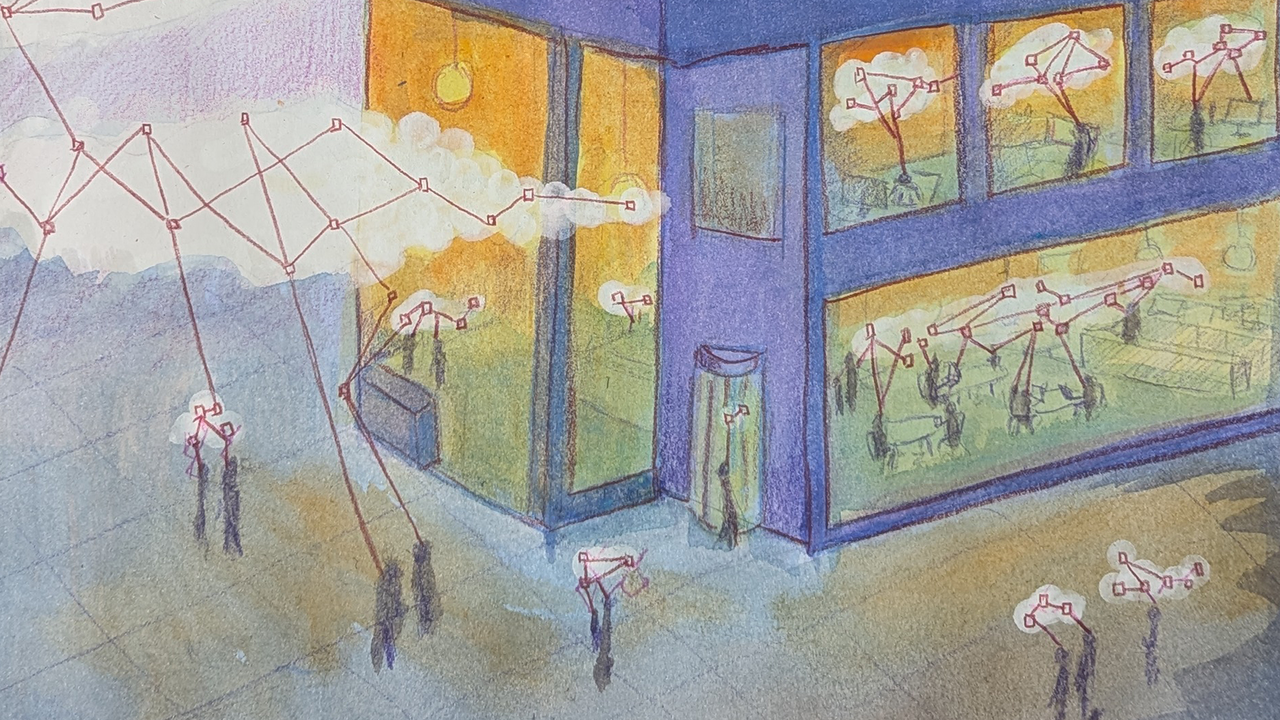
Inage Credit: Jamillah Knowles & Digit / https://betterimagesofai.org / https://creativecommons.org/licenses/by/4.0/
--
How I used AI in developing this blog:
The initial ideas and structure/categorisation is ours, coming from years working with organisations on the deployment of AI technologies.
I used Claude to help me structure the layout and simplify some explanations.
I used ChatGPT to review the blog an importantly to test it against other research/publications on the subject, and to create the visual that is embedded in the article.
Six months after the original publication, I returned to the article, with some observations of my own, but also invited a couple of AI models to challenge my thinking based on the latest research. In particular this resulted in a new distinction between single task agents, and specialist agents
Read next


.png)

We give purpose-driven organisations the confidence to thrive in an AI-enabled world.
A bit about the images on our website: throughout our website we have used images from the wonderful Better Images of AI. They’re a great source of AI-related images, freely available under a Creative Commons license, that specifically avoid Humanoid robots, glowing brains, outstretched robot hands, blue backgrounds, and the Terminator!