Building in the open: how we used AI tools to build our operations dashboard in 20 days
We replaced scattered spreadsheets, shared folders and notes with one secure operations dashboard. The build was led by one of our associates, Rob Balderstone of Appleboar, and it was built in 20 working days using Claude Code and other AI technologies. The tool is already saving our team time. Read on to find out how we went from problem to solution.

As you’d expect, AIConfident is regularly using AI tools in our workflows so we wanted to share something we’ve built recently which is substantially improving operations, and also to improve our clients’ experience too.
What problem were we trying to solve?
We have a CRM, which works well for managing enquiries and new business. But once a client moved into delivery, things became harder to manage. Client information was being recorded in multiple places, internal processes were taking more time than they needed to, and it was not always easy to share the right information with the team member delivering client sessions.
Our internal team carried more of the admin burden, and we knew the client journey could be better. We were also mindful that as a scaling business we wanted to solve the problem in a way that was future-proofed. Data security was paramount of any new system.
What did we build?
Before commissioning anything we built our product specifications. This included thinking through what we actually needed and what options we had for making it work (with thanks to Baz Iyer for their support).
With a clearer sense of product specifications we worked with one of our associates, Rob Balderstone at AppleBoar. Together we designed and built an operations dashboard that now acts as the backbone of the business and will be the central resource for clients. This brings together:
- All delivery information, with views for both the AIConfident team and clients
- Client-specific materials and information about their organisation (such as AI policy or tech stack)
- AIConfident toolkits and resource library
The build process
Rob shared his experience of building the dashboard:
“We spent time early in the project getting as clear as we could on the underlying data model of the platform, as well as the underlying infrastructure. We also prototyped a basic version of the platform so AIConfident could get initial impressions as to how the platform might look, feel, and behave before committing to a direction.
The AI technology we used was predominantly Claude Code - supported by a suite of other more nuanced AI and infrastructure tooling. We also ensured that all code changes and infrastructure decisions were signed off by experienced software engineers prior to reaching production - thus benefiting from the speed, versatility, and cost-efficiency of AI-driven development, without sacrificing confidence in security, stability or scalability.
The build to-date has been a total of 20 working days - getting from intro call through planning, design, testing, to active use in production. This is a fraction of the time that this kind of project would have taken without AI.”
What has changed?
The dashboard is already saving the internal team time. Inbound clients have been growing each quarter, with operational capacity remaining the same, and we now have increased resilience and information is easier to find. It gives us a stronger operational setup for scaling the business, because all our client delivery information is in one structured place.
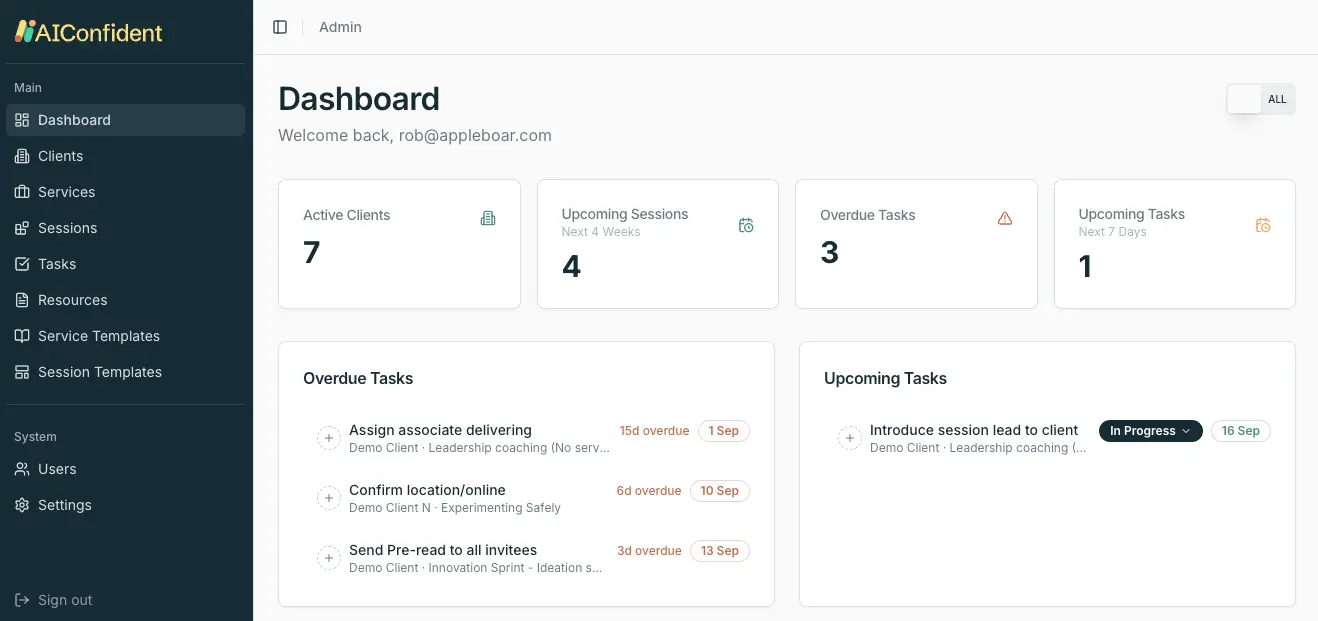
We’re excited to launch a beta version of our client-facing dashboard imminently where we are hoping the experience will be cleaner and quicker, particularly as we’re working with clients on multiple projects over multiple years. With this first version live, we’ll soon be building out personalised action and outcome trackers, so clients can see and manage the actions that come out of their work with us.
What did we learn?
For us, this project is a practical example of how AI tools can help small organisations build useful tools faster - which is why we’re so keen to share it. Unsurprisingly, AI tools were critical in developing this but the real value came from combining them with people who understand how good software is built, tested and maintained, and who know where to rely on human expertise in addition to generative capabilities.
One of the quickest ways to get a win from AI technologies is having someone embedded in your team who understands software development, and who can support the organisation to use AI tools to build bespoke solutions. Without this expertise you can very quickly build an AI tool that takes you in the wrong direction and can miss the safety, governance and data security considerations that should have been there from the start. Having someone who can help steer you the right way, and keep those safeguards in place, is key.
Many organisations have processes held together by spreadsheets, shared folders and repeated manual steps. Not every process needs a bespoke tool, but some do. And with the right approach, it is now much more realistic, and commercially viable to build something useful, secure and tailored to the way your organisation actually works.
We are committed to keep sharing in the open and look forward to sharing more of our experiences with you.
If you’re exploring improving processes in your organisation we can help you build the capacity in-house, whilst being supported by AIConfident’s experts like Rob Balderstone. We’ll also make sure you have the leadership, governance and skills across the organisation, so this becomes part of a wider AI journey, rather than a single fix.
How we used AI in writing this article
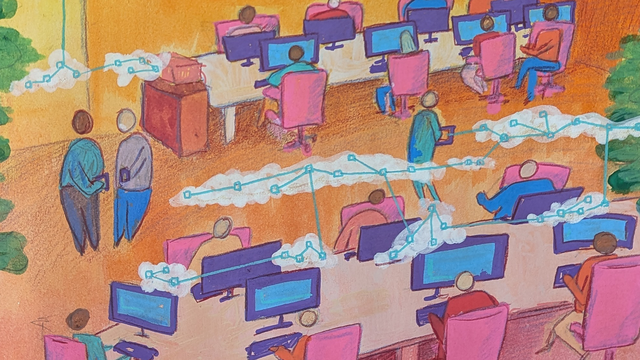
Images in this piece are from Better Images of AI. We use them instead of generic AI stock photography because most AI imagery reinforces public mistrust of AI, leans on harmful stereotypes and spreads misleading cultural tropes about the technology.
Image credit Fabrizio Matarese, Better Images, Creative Commons Licence
.png)


We give purpose-driven organisations the confidence to thrive in an AI-enabled world.
A bit about the images on our website: throughout our website we have used images from the wonderful Better Images of AI. They’re a great source of AI-related images, freely available under a Creative Commons license, that specifically avoid Humanoid robots, glowing brains, outstretched robot hands, blue backgrounds, and the Terminator!