Our impact supporting schools with AI
Since January 2023, we've worked with schools and trusts to help leaders and staff use AI tools safely and with confidence. We've trained over 300 school leaders, reached 1,375 educators and staff, and delivered sessions directly to more than 500 students. As that work comes to a close, we've looked back at what changed, what we learned, and how it continues to shape our support for the organisations that help young people.
Young people need support to use the AI tools available to them today safely and well. They also need to build the skills they'll rely on in the jobs of the future, from critical thinking to knowing when to question what an AI tool tells them. As a dad of 3, and with educators as parents, Tim has always been keen for AIConfident to have impact for people who work with young people, and schools were one of the first places AIConfident worked. In January 2023, one of the first formal ‘AIConfident’ sessions was with Buckswood School in Sussex, and since then we've worked with leaders, staff, students and parents across a wide range of schools and trusts.
After a lot of thought, we’ve made the difficult decision to bring our schools work to a close. Schools increasingly need specialist, education-focused support, and we believe our team can make the biggest difference with charities, the public sector and business. Before we close this chapter, we wanted to look back at what it achieved, what we learned, and how it shapes what we do next.
Where schools were starting from
When we began, most school leaders and staff wanted to use AI tools safely and well, but did not know where to begin. Many were worried about safeguarding, data protection and what AI tools would mean for how students learn. There was rarely a shared framework to build from. Before our sessions, 40% of staff rated their confidence with AI as 1 or 2 out of 5.
What we delivered
Across over 60 cohorts and sessions, our work with schools took four forms:
- School leaders cohorts: 15 different five-module cohorts, covering why AI matters for a school community, experimenting safely, AI policy and ethics, AI literacy, and communicating your approach. It was designed so leaders could build and lead their own school's AI strategy, while also developing their own confidence alongside peers.
- Leadership workshops: 11 dedicated workshops and intensive training days for senior teams.
- Staff professional development: 29 INSET sessions, keynotes and network talks for whole-school staff.
- Student and parent sessions: careers talks and live lessons for students at key stage 3, key stage 4 and A level, plus talks for parents.
The reach, at a glance
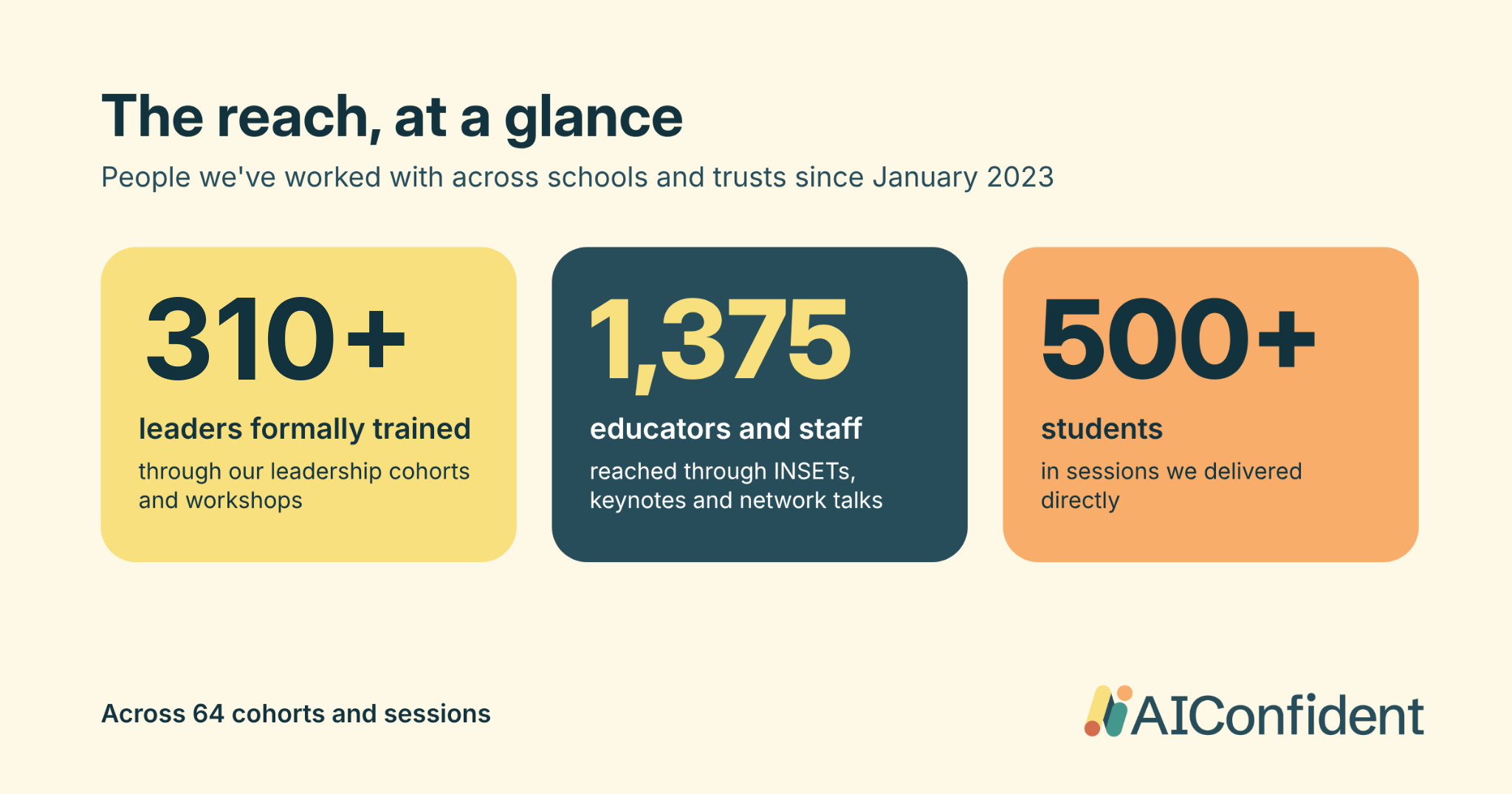
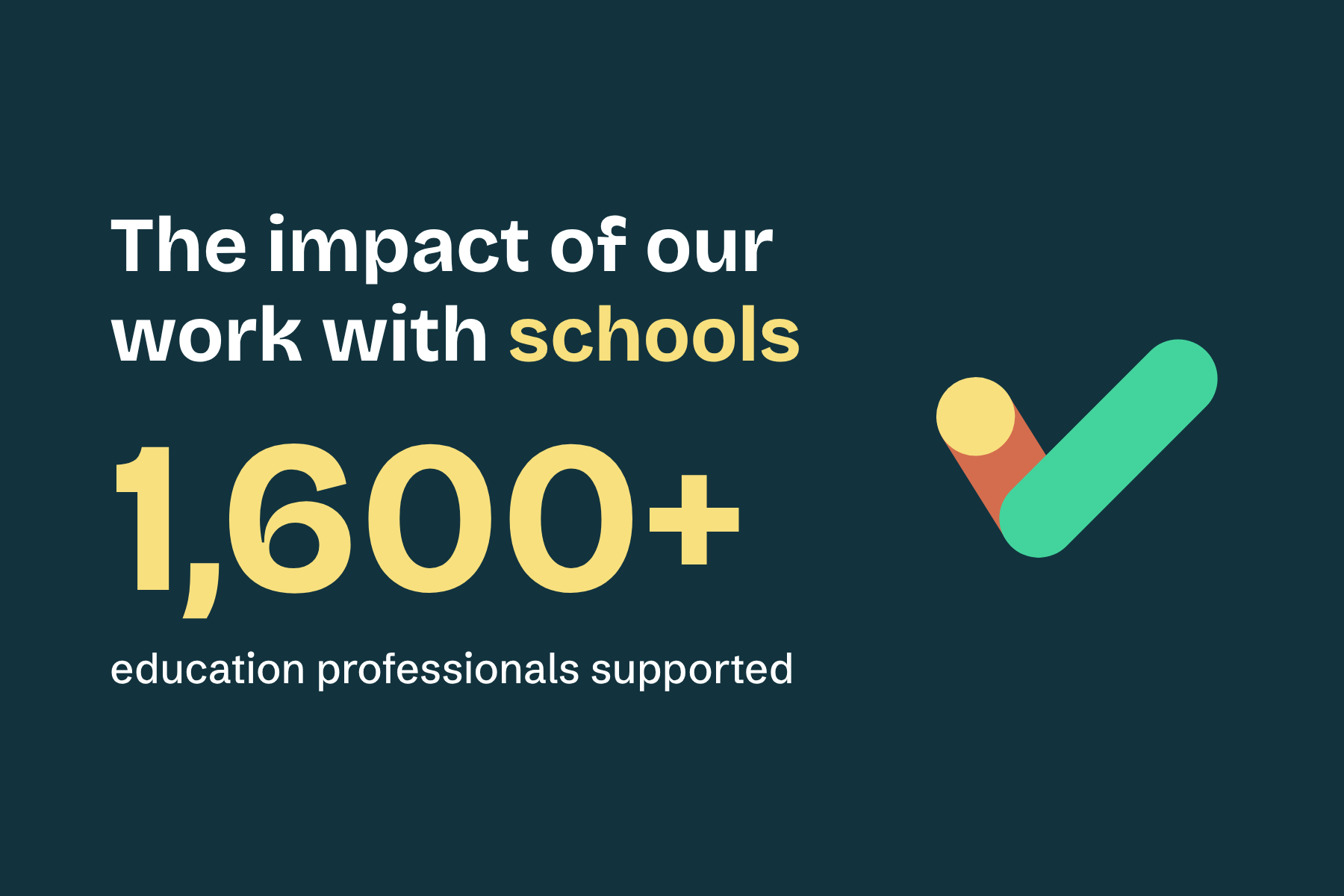
In total, we've worked with over 1,600 education professionals. That includes over 300 leaders formally trained through our cohorts and leadership workshops, and 1,375 educators and staff reached through INSETs, keynotes and network talks. We've also delivered sessions directly to more than 500 students.
What changed for staff
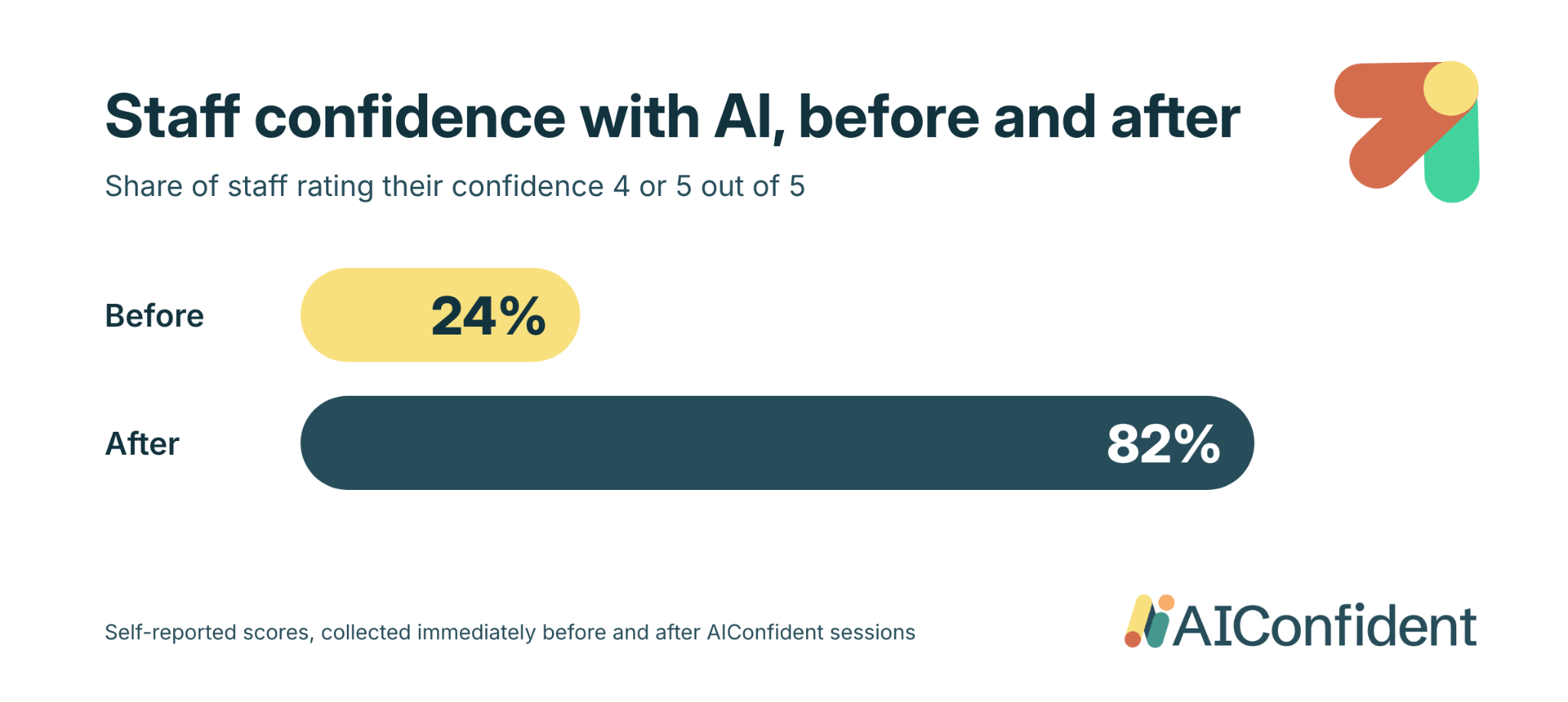
We asked participants to rate their confidence with AI out of 5, immediately before and after each session.
- The share of staff rating their confidence at 4 or 5 rose from 24% to 82%, more than 3 times as many.
- The share rating it at 1 or 2 fell from 40% to 1%.
- The average confidence score rose from 2.6 to 4.1 out of 5.
These are self-reported scores, so they measure how confident people felt rather than a test of skill. Alongside the scores, we asked participants what they planned to do next.
What leaders and staff planned to do next
Participants told us they planned to use AI tools to:
- reduce workload, for example by photographing handwritten notes for analysis, summarising long school policies and drafting routine emails
- create lesson resources, including personalised interactive lesson plans, cross-curricular early years resources and targeted scaffolding for pupils with special educational needs
- engage their school community, by writing assemblies and drafting surveys to ask parents about their views on AI
We also supported several schools and trusts to draft their own generative AI use policies, guiding them through each decision so the policy reflected their own school's priorities.
In their words
What the stats can’t show is how it felt for the people in the room. In their words:
"From starting the course where I was very nervous about AI to the end of the course where I feel confident to lead the school has been wonderful." - Graduate, Greenheart Learning Partnership cohort
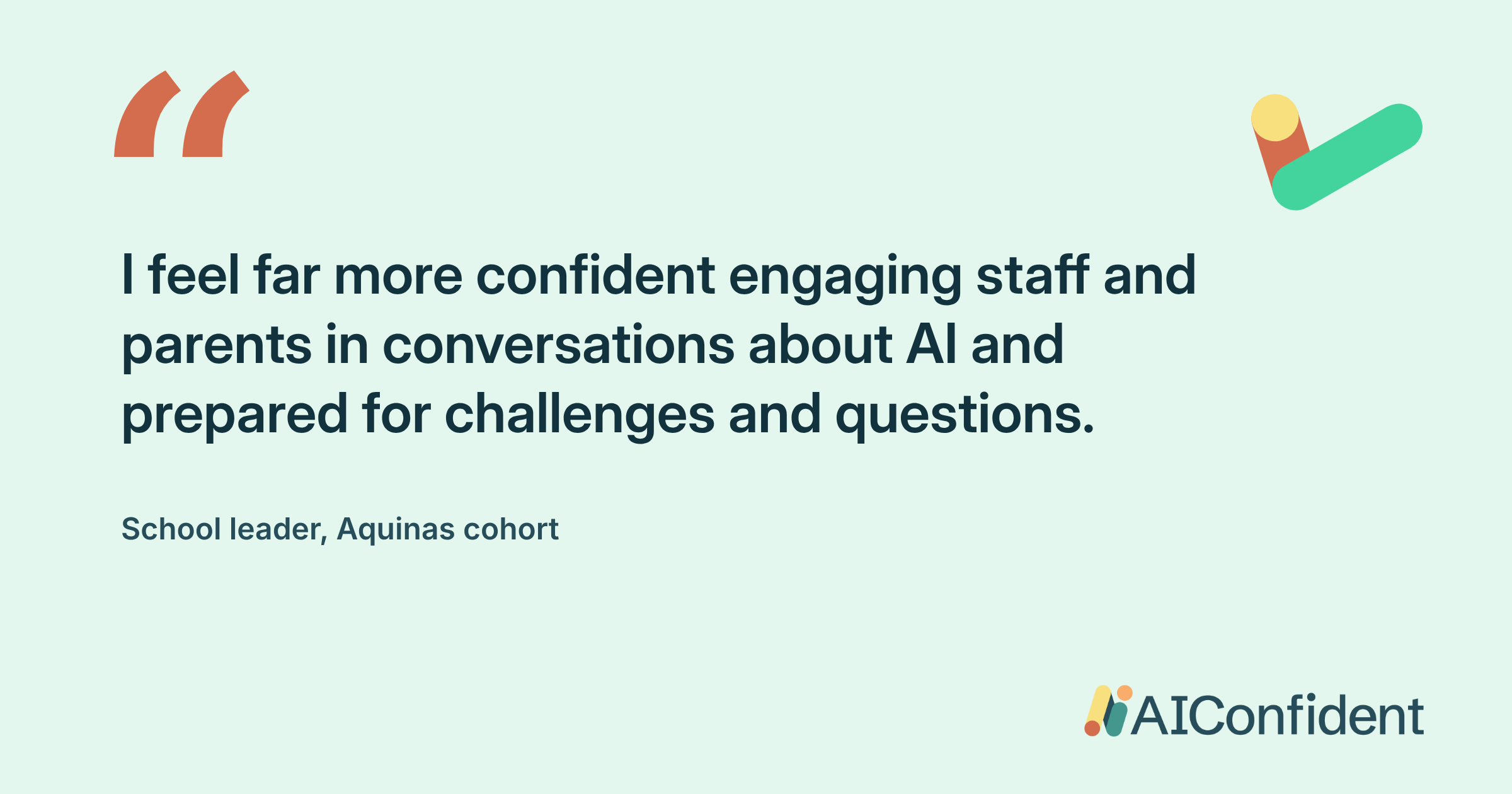
"I knew a little about what AI was before this course but over the sessions my knowledge of current capabilities, uses and ethical considerations is on a completely different level now. As a school leader, the depth of understanding this course provided has changed how confident and capable I am to lead." - Graduate, Aquinas cohort
"I particularly liked you emphasising how important human critical thinking skills are when interacting with AI. Thank you." - Staff member, Dulwich Prep
What happens next
From the start, our work has been split between schools, charities, the public sector and business. Over time, it became clear that schools need specialist support. That means people with a background in education, whose work stays closely tied to education policy as AI guidance for schools develops. There are organisations already doing this brilliantly, dedicated entirely to supporting schools, and we’re confident schools are in good hands.
As a small business, we can’t do everything well, and sometimes that means choosing to step back from work we love. This was one of those times.
So we’re focusing our work on charities, public sector bodies and businesses, where we can draw on the wide range of experience across our delivery team.
Our commitment to young people remains. How they learn, build skills and find work will be shaped by the choices organisations make about AI technologies, and many of the organisations we work with support young people directly. We still offer reduced rates for charities, and we’re proud to be working with some amazing organisations that support young people, including the Youth Futures Foundation, the Education Endowment Foundation, Chance to Shine and Young Women’s Trust among many others.
Our work with schools work taught us a great deal. Above all, we saw how much confidence grows when leaders have the space to experiment safely and set their own direction.
We’d also like to thank Aaron Patching, Education Lead at AIConfident, and Nicki Watts, Neil Almond and Ali Jaffer for all their fantastic delivery.
If your organisation works with young people and would like to talk about how we could support you, get in touch.
How AI was used in writing this
We used Claude to help pull together the first draft of this article, using a prompt from Lauren that set out what the article should include and how it should be framed. We let Claude read our Google Drive for the relevant data. Lauren then edited and checked the copy, and Tim reviewed it.
The images in this blog were created with Claude, using a skill we've set up with our brand colours, files and tone of voice.
Read next




We give purpose-driven organisations the confidence to thrive in an AI-enabled world.
A bit about the images on our website: throughout our website we have used images from the wonderful Better Images of AI. They’re a great source of AI-related images, freely available under a Creative Commons license, that specifically avoid Humanoid robots, glowing brains, outstretched robot hands, blue backgrounds, and the Terminator!